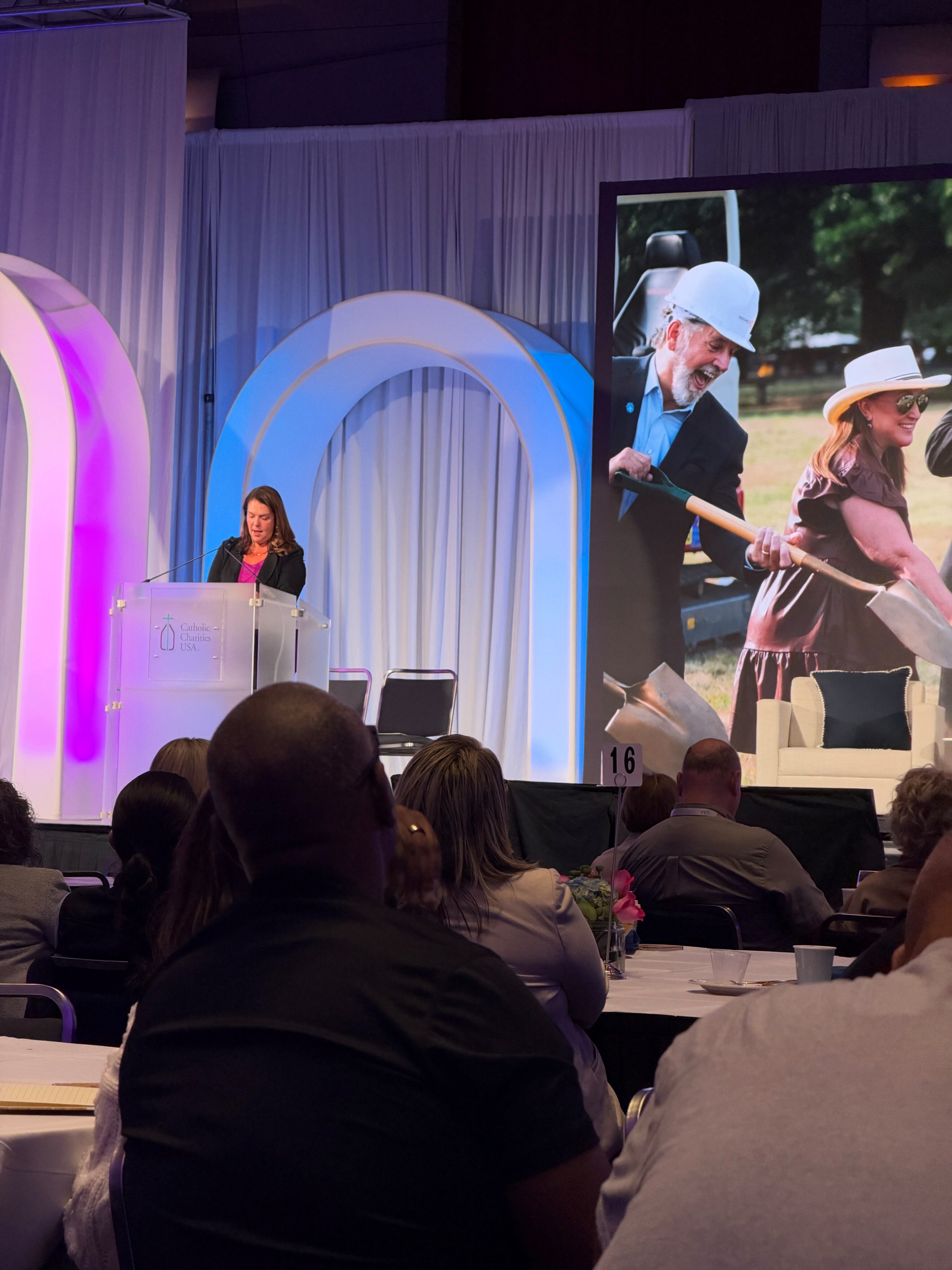
A familiar teaching took on renewed meaning at this month’s Catholic Charities USA gathering. As Catholic Charities of Oregon prepares to resume refugee resettlement, CEO Kaleen Deatherage reflects on the responsibilities of welcome and the possibilities it creates for our communities.

Dear Friends,
Some teachings become so familiar that we can stop hearing how much they ask of us.
“Welcome the stranger” is one of them.
Earlier this month, I joined Catholic Charities colleagues from across the country in Richmond, Virginia, for Catholic Charities USA’s annual gathering. The theme, “The Bridges We Build,” spoke directly to our shared work helping people find their way to safety, stability and a community where they belong.
One speaker brought that responsibility into especially sharp focus. Meghan Sullivan, a University of Notre Dame philosophy professor, reflected on the Good Samaritan and what it means to love the stranger.
I came home thinking about the distance between embracing that teaching and putting it into practice, especially when the person who needs our welcome challenges our expectations.
A familiar teaching, a demanding invitation
Many of us grew up hearing the story of the Good Samaritan. Its call to care for someone beyond our own circle resonates across faiths and backgrounds.
Yet the story asks more of us than recognizing that kindness is good. The Samaritan stops. He draws close enough to see what is needed. He gives his time and resources, and makes arrangements for care to continue after he leaves.
His compassion becomes a commitment.
At Catholic Charities of Oregon, we see the importance of that commitment every day. A woman experiencing homelessness needs someone who will listen and help her take the next step toward housing. A parent struggling to afford groceries needs food and a way to keep the household steady. A family beginning life in an unfamiliar country needs practical guidance and people it can trust.
Welcome becomes meaningful through what we do next.
Preparing to welcome again
That understanding is guiding us as we prepare to resume refugee resettlement in Oregon.
Catholic Charities USA is taking on the national resettlement role previously held by the United States Conference of Catholic Bishops. For our agency, this next chapter offers an opportunity to put our experience, relationships and commitment to work for families arriving through an approved refugee admissions process.
The federal government determines who is admitted as a refugee. Our responsibility is to help the people entrusted to our care begin rebuilding their lives.
That work is deeply practical. It means preparing for a family’s arrival, helping parents navigate school enrollment, connecting people with employment resources and supporting them as they learn how to manage daily life in a new place.
It also means recognizing what they bring with them: skills, ambitions, traditions and the ability to shape their own futures. Too often, conversations about refugees and immigrants focus on the challenges they face, leaving little room for the promise of what they will contribute. We see future coworkers, business owners, voluneers and neighbors whose ideas and experiences can help a community grow. Our investment in their potential is also an investment in the neighborhoods they will call home.
A successful welcome makes room for all of that.
Holding fast to our values
I recognize that refugee resettlement brings questions, including among people who care deeply about our mission. Some may question our participation. Others may question whom we will serve.
We owe those questions a thoughtful answer.
Our commitment to human dignity applies across race, religion and nationality. We will bring that commitment to every family we serve, and we will continue to support opportunities for people fleeing persecution to find safety.
Providing care to a family does not require agreement with every policy that shaped its journey here. It does require us to see its members as individuals, each with a story we have yet to hear.
We believe we have a responsibility to remain engaged – to offer the care we can provide today, bring our experience to decisions about tomorrow and speak up for people whose needs remain unmet.
Having a seat at the table carries an obligation to use our voice. It also allows us to help turn decisions into responsible, compassionate care.
What welcome makes possible
For Catholic Charities of Oregon, resuming this work means carrying forward a longstanding mission with renewed purpose.
For Oregon, it offers an opportunity for parishes, employers, volunteers and neighbors to help families establish a secure footing and become part of community life. Those relationships can change everyone involved. Working alongside someone whose life has been different from our own can deepen our understanding, broaden our perspective and reveal possibilities we might otherwise have missed.
For our country, it is a chance to put enduring values into practice through the everyday work of helping people begin again. It is also an opportunity to recognize how much our shared future stands to gain from people ready to build a life here. Their contributions will become part of our country’s next chapter.
We should approach that work with care. Families need dependable support. Communities need preparation and partnership. Good intentions must be matched by the resources and follow-through that help a welcome last.
I returned from Richmond encouraged by colleagues across the Catholic Charities network who are doing precisely that work, often under difficult circumstances. Their example strengthened my confidence in what we can accomplish together here in Oregon.
The stranger is someone we do not yet know. Our willingness to draw closer can change that.
Thank you for helping us make that welcome possible.
With gratitude,
Kaleen Deatherage
Chief Executive Officer
Catholic Charities of Oregon